
Introduction
A major geopolitical development has taken place: India and the United States have signed a 10-year defense framework pact.
The History of the India-US Defense Pact
The roots of this partnership go back to 2005, when India and the United States first signed a 10-year defense cooperation framework. The original agreement aimed to strengthen military collaboration through:
- Joint weapons development
- Technology sharing
- Increased intelligence cooperation
That pact expired in 2015, after which it was renewed for another decade. Now, in 2025, the two nations have once again extended the agreement, marking 20 years of ongoing defense collaboration.
However, despite the optimistic headlines, many of the initial goals — such as joint weapons production — have not materialized.
What’s New in the 2025 Agreement
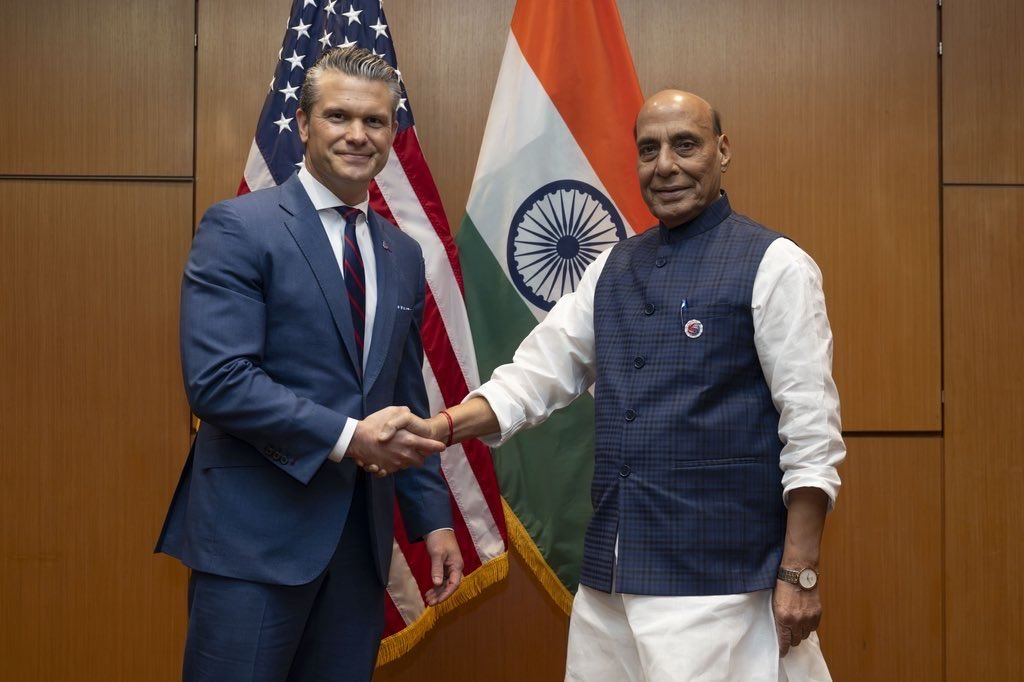
The latest extension was signed not in New Delhi or Washington, but in Malaysia, where Indian Defense Minister Rajnath Singh met with Pete Hegseth, the current U.S. Secretary of War.
According to official statements, the updated pact emphasizes:
- Continued defense technology cooperation
- Supply chain resilience
- Maritime security in the Indo-Pacific region
Yet, details on specific projects remain unclear. Reports suggest that India and the U.S. are exploring joint production of the Stryker combat vehicle, but no official confirmation has been made.
Comparison with Other Defense Partnerships
When comparing India’s defense relations with other nations, it’s evident that the India-U.S. partnership has produced fewer tangible results in terms of joint manufacturing.
India-Israel Partnership
- Co-developed the Barak 8 surface-to-air missile system
- Collaborated on drone technology, actively used in recent border operations
India-Russia Partnership
- Jointly developed the BrahMos missile, a major export success (including sales to the Philippines)
India-France Partnership
- Established a long-term roadmap for defense cooperation until 2047, beyond the typical 10-year framework
Other Collaborations
- Active defense discussions with the UK, Vietnam, Australia, and Japan
- Several agreements for technology sharing and training, though with no fixed duration
These examples highlight that India’s most productive defense collaborations — in terms of actual joint production — are with Israel and Russia, not the U.S.
The Reality Behind the Headlines
While the renewal of the India-U.S. defense pact is being celebrated globally, its practical outcomes have so far been limited. Many analysts believe that the agreement is more symbolic than transformative, serving as a diplomatic reaffirmation rather than a milestone in military production.
However, there is one clear advantage: the United States remains the largest importer of Indian defense supplies, including:
- Aircraft components
- Protective gear (helmets, vests)
- Ammunition and small arms parts
This trade relationship reflects a growing trust, even if full-scale defense co-production remains elusive.
Conclusion
The renewed India-USA 10-Year Defense Pact signals the continuation of a two-decade strategic relationship, not the beginning of a new one.
While the agreement strengthens political and defense ties, the true test will lie in joint production, technology sharing, and on-ground implementation.
Until the two nations produce a successful joint system — like the Barak 8 with Israel or BrahMos with Russia — the partnership will remain more diplomatic than industrial.